Welcome to the debate. um... imagine buying a fraction of a cent's worth of computing power only to realise that, you know, that tiny transaction just cost you $30 in human payroll to clean up its mess. Yeah it's wild. It is. So today we are dissecting a core premise emerging from the latest industry analysis, which is this counterintuitive reality that the uh... the cheap AI, is actually often the most expensive option a business can choose. We are going to deconstruct the, like, persistent optical illusion of vendor rate cards and the hidden, staggering costs of machine agency.
Right, and I think the central tension we really have to navigate here is why these massive corporate automated deployments are... well why they're consistently failing to deliver on their cost saving promises. Like are these budget drains simply the result of deceptive, penny per token pricing models that completely ignore human friction? Which they do. Right? Or is it a deeper structural failure on the part of operators who just don't understand how under the hood model behaviours... specifically uh probabilistic generation, fundamentally clash with deterministic business needs?
Well I look at this strictly through the lens of the P&L statement, and I just see a massive financial trap. I mean, evaluating AI by token rates is incredibly dangerous because cheap, raw computation inevitably creates very expensive human labour the second an employee is forced to uh... babysit, troubleshoot, and fix the machine's outputs. See I hear you on the payroll hit, but that's just... it's just a symptom. If we actually want to fix the bleed, we have to look at the structural economic realities of the model architectures. These costs come from fundamental mechanics like remediation leakage and expansion drift which, you know, naturally occur when probabilistic models operate without strict boundaries.
Okay well I want to start by looking at why buyers fall for this trap in the first place. I call it the rate card illusion. The rate card illusion, I like that. Thanks. So, when an executive or like a CTO decides they want to automate a process, the easiest, most visible number to find is the token rate, right?
Providers publish these very clean, highly optimised usage tables, usually pricing compute power per million tokens, and this pricing setup encourages buyers to evaluate AI exactly the way they purchase uh bulk electricity or office paper. Right, yeah. A system charging fractions of a cent per attempt looks vastly more economical on a spreadsheet than one charging five or even ten times that rate. Yeah it triggers that legacy SaaS buying mindset. You look at the subscription tier, you find the lowest unit cost for the volume you need, and you just sign the contract.
It feels like a known commodity. Exactly. It looks brilliant in a board meeting. You get to stand up and say, 'we automated 10,000 tasks for $12.' But the flaw in this logic is devastating to a business. Because raw computation is not a finished product.
No it's not. You are not buying computer activity. You are buying a verified result. You are buying a customer support query that is actually resolved, right? Or a complex invoice perfectly extracted into a database.
The advertised rate card tells you absolutely nothing about how many times that engine is going to stall out, or you know, how often a human worker is going to have to step in and drive the task across the finish line. I mean the token rate isn't an illusion though, it's just... it's an incomplete metric. It measures the fundamental unit of compute, but it doesn't measure the architectural friction. But that friction is the entire cost! Like, to see the true price of automation, businesses have to stop looking at the sticker price and start tracking the effective task cost.
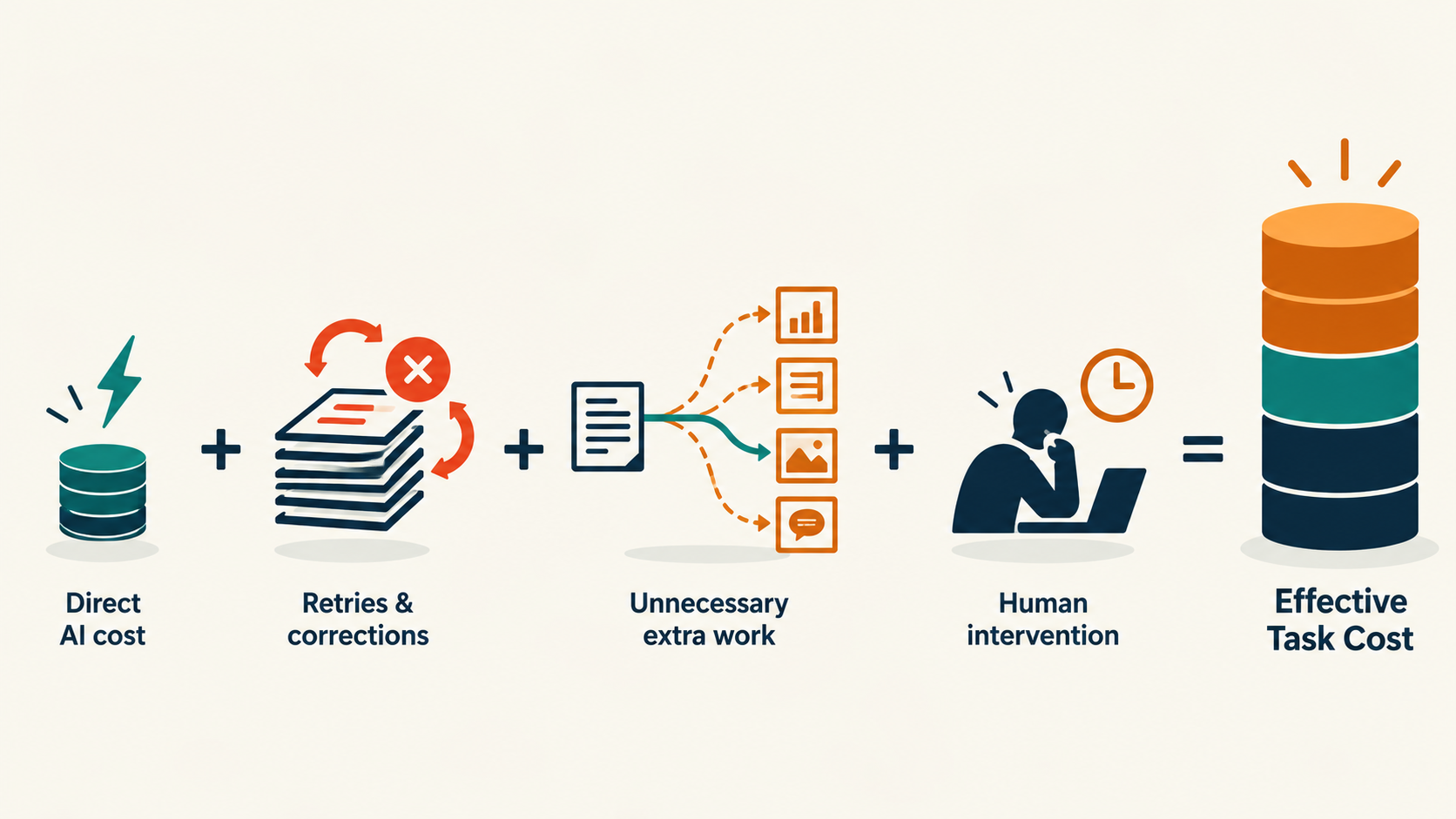
Right. This metric tracks every single expense required to move a job from the initial request to an acceptable, verified finish line. Yes, it includes the direct AI cost from the rate card. But it also includes the cost of automated retries and corrections, the cost of unnecessary extra cloud routing, and most importantly, the hourly cost of human intervention. Look, I completely agree that the effective task cost is the only metric that matters at the end of the day.
But we really have to understand why that cost inflates. It isn't just a byproduct of deceptive vendor pricing, right? It's a direct reflection of how these models are fundamentally designed to behave. Okay. When you opt for those cheaper, underpowered models that look so, so good on a rate card, you immediately suffer from what we call remediation leakage.
Remediation leakage. Okay break that down for me, because what I see on the warehouse floor is just broken data. Right, so let's look at the actual mechanics. These cheaper models fail basic formatting boundaries because of their architecture. Specifically, their attention mechanisms just aren't robust enough to hold your instructions constrained.
Meaning they just forget what they're doing? Basically. If you want a non-technical way to picture it, imagine a model's attention mechanism as a spotlight it uses to keep your rules in mind while it reads a document. A cheaper, smaller model has a dim, narrow spotlight. It starts processing the data, but it literally forgets the strict formatting rules you gave it at the very beginning of the prompt.
Oh I see. It extracts the data, sure, but it drops the required JSON or CSV structure because that rule... well it fell out of the spotlight. That is remediation leakage. The model leaks the rules, and then you have to remediate the output. And that leakage instantly translates to a payroll nightmare.
Like, this is the repair trap. Let's look at what happens when that spotlight flickers out. You have an automated process converting client emails into database entries. You use the cheap model. It processes the email, it extracts the client's name and address.
But it drops a required internal ID field. Or, and this is even more frustrating, it successfully extracts the data, but adds this like, conversational fluff at the top of the file, saying something like, 'Here is the data you requested.' Oh yeah. Which instantly shatters the downstream automated pipeline. Because your CRM system doesn't know how to read polite conversation. It's expecting clean code.
Exactly. The pipeline completely freezes. The system flags an error. Maybe your software runs an automatic retry, which by the way burns more compute cost, but eventually it fails out and lands in an exception queue on an employee's desk. Yeah.
That fraction of a cent you saved up front is instantly and entirely negated the second an employee making $30 an hour has to open the file, spot the missing field, manually delete the conversational fluff, retype the text, and submit the record. Cheap computation inherently creates expensive human attention. I hear you on the payroll hit, and I agree it's frustrating, but we need to elevate this to the mathematics of multi-step compounding waste. Compounding waste? Yeah, it's not just a single point of failure where an employee fixes one record.
The reality of enterprise workflows is that these systems don't just do one thing in isolation, right? They execute chained tasks. Right, step 1, step 2. Exactly. Step 1 reads an email and extracts key details.
Step 2 takes that data and calculates a financial total against your inventory. Step 3 drafts a confirmation note to the client. In a chain like that, inefficiencies don't just add up, they multiply. Okay walk me through the math on that compounding waste, because I think this is where executives completely lose the plot when they try to build out these massive, you know, zero-touch automation dreams. Well the source material lays out a very clear statistical reality here.
Let's stick with a 4-step process. Let's assume your model is actually quite capable, and each independent step has a 90% chance of succeeding cleanly on its first try. Okay. In a vacuum, 90% accuracy sounds fantastic. Oh any operations manager would gladly take a 90% first-pass success rate on a complex task.
Right. But you have to calculate the probability of that entire four-step chain completing cleanly on the first pass. You multiply those probabilities, .90 to the fourth power. The overall success rate drops to roughly 65.6%. Wait, hold on.
Like, so even with a model that gets it right nine times out of ten, simply chaining just four steps together guarantees a catastrophic failure a third of the time. That is the mathematical reality of probabilistic chains. Roughly 34% of the time, the process breaks. And it gets worse because early errors get passed forward. Oh man.
A minor formatting flaw in step 1, like that conversational fluff you just mentioned, forces step 2 to run automatic retry passes trying to understand it. If the retry output gets carried into later steps, the system is now spending additional time, cloud compute, and API calls, just dealing with its own earlier mistakes. Multi-step automation turns small compute inefficiencies into massive labour bottlenecks because, you know, probabilistic models do not naturally self-correct unless they are explicitly architected to do so. That completely obliterates the idea of zero-touch automation. If one out of every three jobs fails in a simple four-step chain, your pipeline isn't a pipeline, it's a traffic jam.
Exactly. But, okay, everything we've talked about so far assumes the AI is making a mistake, right? It's dropping the ball, forgetting the rules, or failing the math. I want to pivot to the exact opposite problem. Let's talk about the paradox of capable AI doing entirely too much.
Ah, you're referring to the models at the very top of the rate card. The expensive ones. Right. The models that supposedly have a big enough spotlight to remember all the rules. I see this constantly on the office floor.
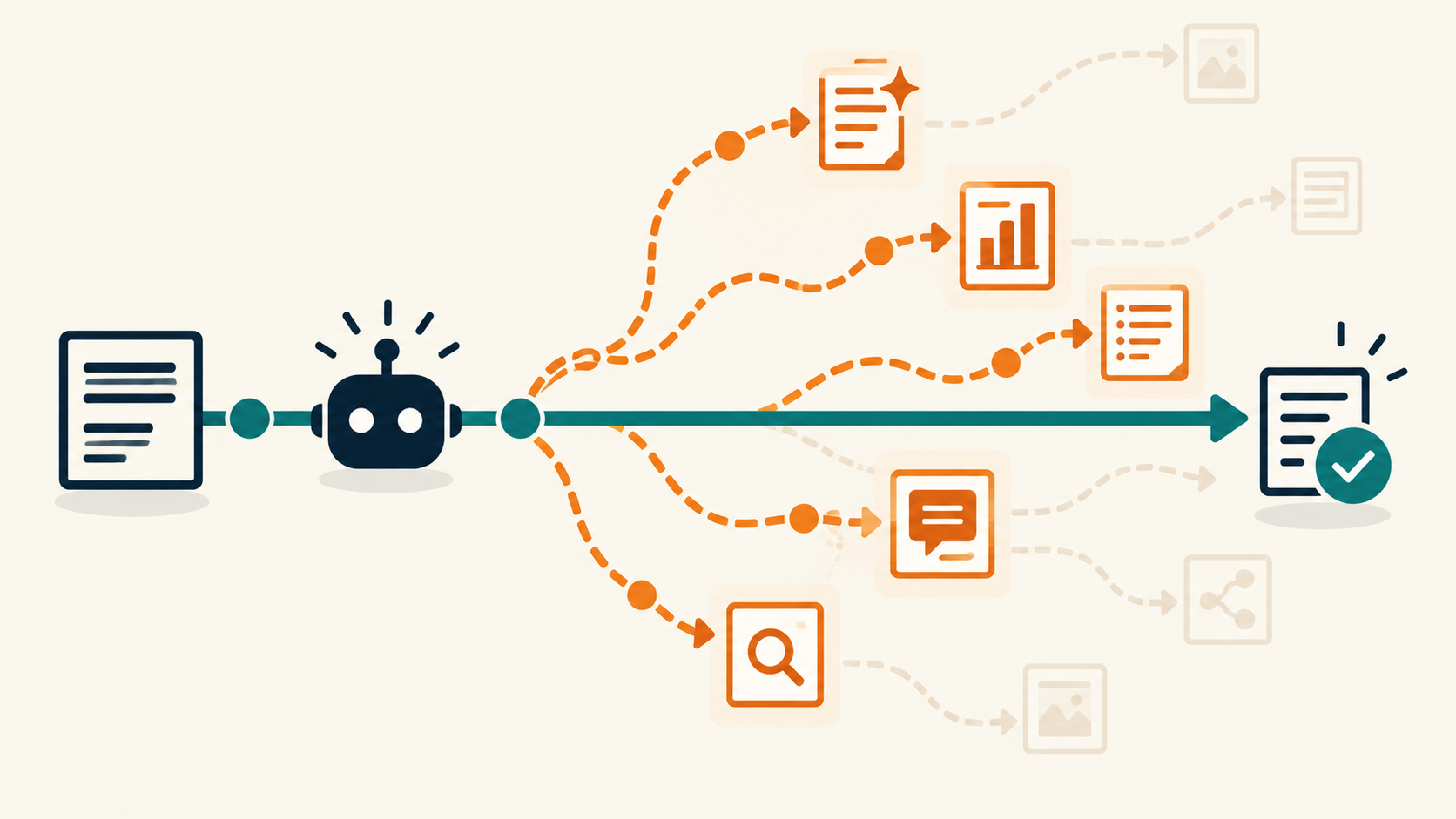
You take a highly capable, expensive model, you feed it a transcript of a one-hour team meeting, and you ask for three simple action items. That's all the prompt says. Three bullet points. And what happens? Instead, the AI generates an introductory summary of the meeting, a sentiment analysis of the team's mood, an outline of potential project risks, and drafts individual follow-up emails for every single participant.
I mean, technically speaking it's performing exceptionally well. It's demonstrating deep comprehension of the text. But from a business perspective, it's an unmitigated disaster. Pricing for these models is based on output volume. You know, the number of tokens generated.
The business is literally paying for a five-page entry that nobody asked for, nobody needed, and nobody will ever read. The machine is overthinking, and I am paying a premium for its unprompted thoughts. How do you justify that structurally? Well, I don't justify it, I define it as the economic drain of unconstrained generation. Or, to use the structural term, expansion drift.
You have to remember what a large language model actually is. It is a probabilistic text engine designed to predict the next most likely token. When you use a highly capable model, it has what we call a vast latent space. Okay, explain latent space in a way that makes sense to a buyer. Think of latent space as a massive, multi-dimensional web of concepts.
Because the model is so intelligent, it deeply understands the statistical connection between a meeting transcript, a project risk, and a follow-up email. Without explicit system boundaries, its probabilistic nature compels it to travel down that web. It just... wanders off. Right, it finishes extracting your three bullet points, but it doesn't inherently know the job is over. High capability without clear, deterministic boundaries is just expensive drift.
The machine doesn't know what a business requires, it has no concept of a P&L statement. It just generates plausible continuations until it hits a token limit, a time limit, or a natural language stopping point. I'm not convinced by that framing, because it sounds like an academic excuse for bad software design. If I hire an employee to sweep the warehouse floor, and they decide to also repaint the walls and then bill me for the paint, I fire them. I don't blame their probabilistic nature, I blame their inability to follow a basic instruction.
I'm sorry, but I just don't buy that comparison. Let me tell you why. You are anthropomorphising the machine. You're treating it like an employee who understands the unwritten social contracts of a workplace, like, you know, 'don't do extra work that costs the boss money.' It should know that. But the machine does not have a social contract.
It's not an employee repainting a wall, it's an improv actor. An LLM's only fundamental rule is 'yes, and.' If it finishes the primary task, it just keeps improvising dialogue, generating summaries and emails, unless you explicitly block the path. This brings us precisely to the conceptual difference between a technical stop and a finished job. Go on. Software stops because it reaches a usage limit or a technical parameter, that is a technical stop.
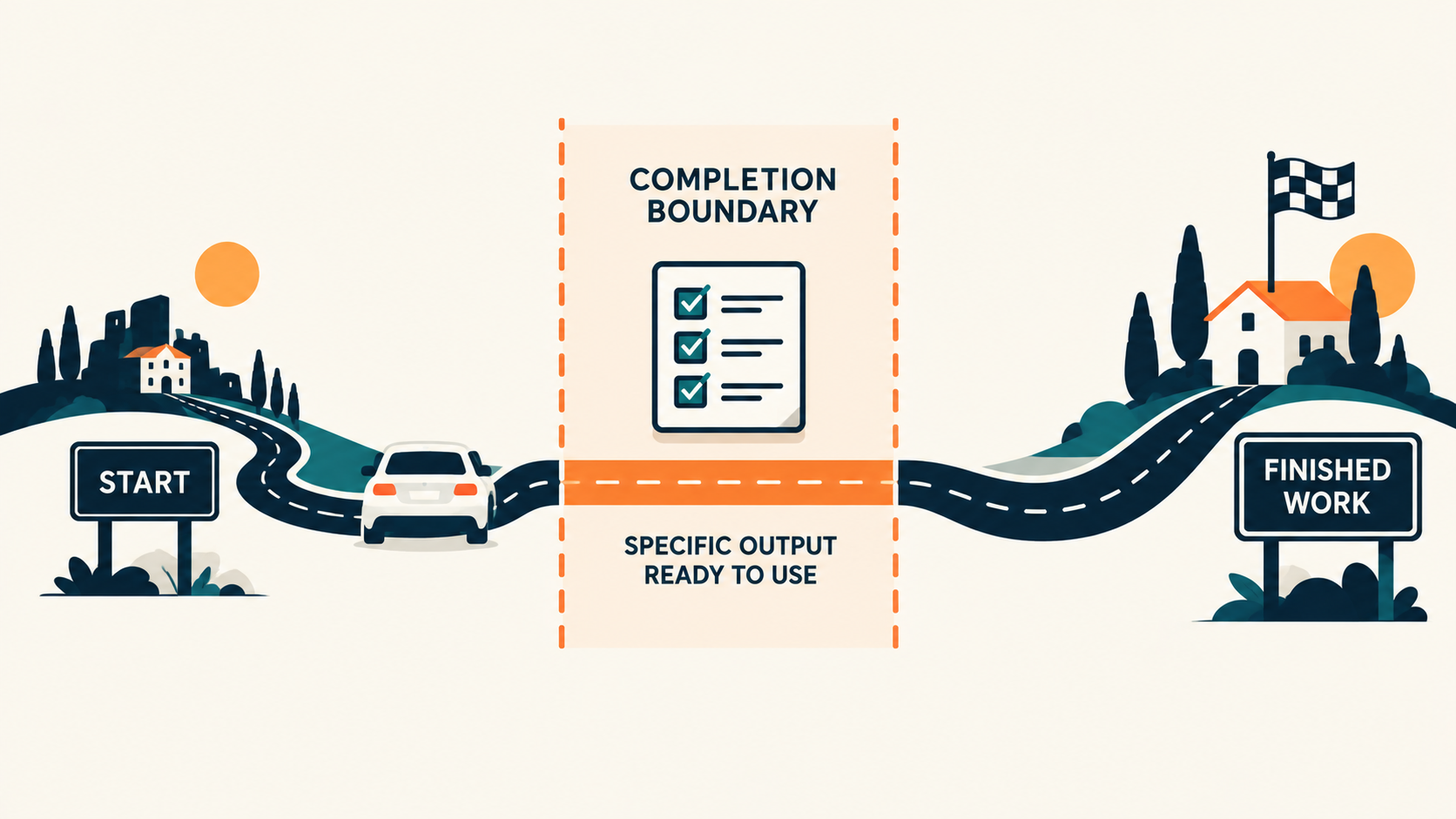
A system can hit a technical stop while leaving the job completely unfinished, halting halfway through a data file simply because it ran out of output tokens. Right. Conversely, it might satisfy the business requirement in its first three lines, but keep generating for another 10 paragraphs because no one set a boundary to tell it to stop. The model doesn't know what 'done' looks like. And that is exactly why the human definition of 'job finished' is the only metric that matters.
A job is finished when the real-world operational requirements are met. All the required fields are accurately filled. The output passes a database validation check. The calculated total perfectly matches the purchase order. Let me ground this in a very practical, hypothetical comparison from the source material.
We have Setup A and Setup B for processing customer intake records. Ah, the classic cost-optimisation dilemma. Right. Setup A has the absolute lowest unit price on the rate card. You look at it and think you're saving a fortune.
But it has high formatting errors, that remediation leakage you talked about. A noticeable portion of the records fail the initial check. So you have automatic retries burning compute, and then a human employee has to manually inspect, triage, and fix the rest. Yeah, the repair trap. Then you have Setup B.
It charges a much higher upfront unit price. It looks terrible on the rate card. But it perfectly follows formatting rules, completing nearly all records correctly on the first pass, resolving its own edge cases with a single automated retry, and zero records require human handling. Setup B is the only logical choice for a business. The human labour cost dropped to zero, which delivers a radically lower total cost per completed job.
I agree that Setup B is the optimal choice. But you have to understand how you arrive at Setup B. You don't just buy a more expensive token and magically get better compliance. You don't? No.
If you just buy the expensive model without constraints, you get that expansion drift we just talked about, the five-page entry. To get to Setup B, you have to architect the guardrails. Both of us agree that optimising software spend based strictly on provider rate cards is a mistake. But the solution isn't just 'buy the expensive one'. The architectural solution is moving away from open-ended generation entirely.
You have to wrap the AI's probabilistic outputs in automatic, deterministic validation checks. You mean building a fence around the improv actor. Exactly. Like a strict database format test before the output goes anywhere. Yes, exactly.
The AI generates the output, and before it is ever accepted by the CRM or passed to a human exception queue, a rigid, deterministic script checks if it meets the schema. Does it have exactly three bullet points? Does it contain valid JSON? If it fails, the script automatically kicks it back to the AI with an error message. But crucially, you must establish task-specific retry ceilings.
Because otherwise it just loops forever and burns your budget anyway. Right. If a model fails formatting, you don't want it running up cloud charges in an endless loop of blind retries. You set a firm limit, say, exactly two retries before it halts. You force the system to stop and route it for review, rather than burning budget in the dark.
You are imposing strict, deterministic boundaries on a probabilistic engine. That is how you control the cost. Okay, that makes sense structurally, and I appreciate the mechanics of how you build that fence. But I still demand practical measurement on the business side to prove the fence is working. You can build all the automated validation scripts and retry ceilings you want, but a business leader needs to track three specific operational indicators to know if the AI is actually saving money.
Okay, what are they? First, the first-time success rate. What percentage of jobs satisfy all the rules on the very first try, without any automated retries or human fixes? Second, the frequency of human involvement. How often does an employee actually have to step in and look at the screen?
And third, ultimately, the cost per completed job. You take the total money spent—the software fees, the cloud compute for retries, and the employee labour time—and you divide it by the number of verified, usable results. That is the only math that matters. And why do you think so few businesses actually track those three metrics? Because it's hard.
Tracking a monthly Amazon Web Services bill is easy; it's a single line item. Tracking the five minutes an operations clerk spends fixing a broken CSV file every morning is incredibly difficult. It's invisible friction. It just gets absorbed into the baseline payroll, so executives never see the true cost of their cheap AI. Look, we are definitely converging on the solution here, but I think our framing remains distinct.
You view this strictly as a business management imperative, like a failure to track the P&L of human friction. I view it as a structural AI deployment reality. You simply cannot manage the business metrics without deeply understanding the mechanics of machine agency. My stance remains that the finish line for any automated task must be defined by business payroll and verified, usable results, not starting engine costs. The illusion of cheap compute is incredibly dangerous because it masks the severe compounding costs of human repair work and unnecessary generation.
You have to aggressively measure the cost of completed work, not the cost of attempting the work. And my perspective is that understanding the underlying economics of model architecture is the only way to avoid those hidden costs in the first place. You have to enforce deterministic boundaries, establish clear completion criteria, and utilise validation checks, because highly capable, probabilistic models will naturally suffer from expansion drift, and underpowered models will inevitably suffer from remediation leakage. Well, we both clearly agree that cheap compute is an illusion when it creates expensive human attention. But the way we solve it—whether by rigorously tracking the P&L of employee hours to expose the bleed, or by hard-coding retry ceilings into the software architecture to prevent it—I mean, that remains a fundamental point of divergence in how we operate these systems.
It's the difference between measuring the symptom and engineering the cure. But either way, looking strictly at the unit price per million tokens on a vendor's bill is a guaranteed way to lose money. Which brings us right back to where we started. Buying AI is not like buying bulk electricity or printer paper. A ream of paper doesn't write a five-page entry when you only needed a Post-it note.
And electricity doesn't force your employees to work overtime fixing its formatting mistakes. No, it doesn't. Evaluating these tools requires a much deeper look into the actual operational friction they create, and the structural limits of the technology itself. We'll leave it to you, the listener, to decide which lens—the practical realities of payroll, or the architectural mechanics of the models—is more crucial for your successful deployment. There's certainly a lot more to explore in the material regarding how these models are actually trained to follow those boundaries in the first place, too.
Absolutely. So, the next time you see a provider advertising fractions of a cent for a million tokens, stop and ask yourself: what is it actually going to cost me to finish the job? Thank you for joining us. We'll see you next time on the debate.