Why The Visit Matters Economically
A central building block of the commercial internet is not the link, the database, or the app. It is the destination visit.
For thirty years, digital business models have relied on a simple physical setup: a human being looking at a visual screen. Whether searching for a flight, reading news, comparing shoes, or checking a restaurant menu, the user experience followed a familiar path. A person opened a web browser, navigated to a specific address, scrolled through a visual layout, and interacted directly with what appeared on the display.
To a user, a website visit feels like a single action. To the business operating that site, a visit has traditionally been a bundle of five distinct events occurring at once:
This bundling enabled the growth of major digital platforms. In platform economics, market strength often stems from hosting consumer attention at the interface layer. Search engines, social networks, and e-commerce marketplaces built significant value by placing themselves directly between user intent and underlying suppliers.
Because millions of people are using these visual interfaces as their main entryway to the internet, platforms gather substantial user attention. They monetise that attention by charging merchants and advertisers for access to it. So long as the visual interface remains a primary path for getting things done online, hosting the page visit provides a reliable way to generate revenue.
What Changes When AI Stands Between The User And The Site
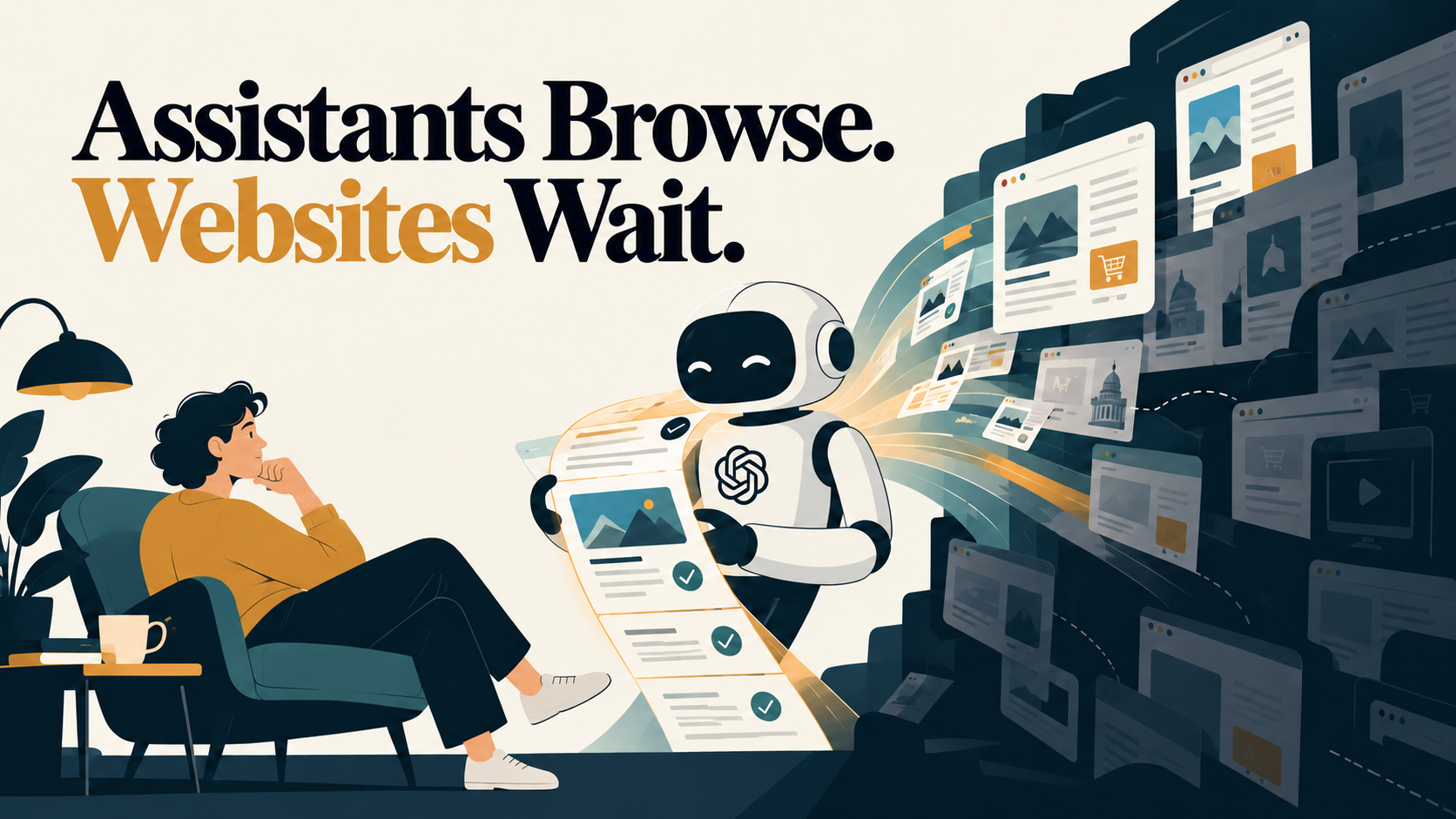
The path of navigating through a visual interface to complete a task changes when an artificial intelligence assistant acts as an intermediary proxy between the user and the web.
Consider a user planning a travel itinerary or checking for a replacement appliance part. In a conventional setup, that user visits several websites, opens multiple browser tabs, clicks past promotional banners, compares specifications manually, and moves through a visual checkout process.
When an assistant is involved, the interaction path can shift:
Traditional Path
User → Platform Interface → Display Ads & Tracking → Supplier Page
Assistant-mediated Path
User → AI Proxy → Data Query or Page Search → Summarised Result
The user describes their goal to an AI proxy—focusing on criteria like budget, dimensions, availability, or delivery timing. The assistant can query available data feeds, search relevant web pages, parse details across multiple sources, and present a direct recommendation or execute a request.
The core mechanism is interface abstraction. An AI assistant can separate user intent from the physical page visit. The user receives the outcome of a search, but direct human visits to the underlying websites may become less frequent or occur only at the final point of confirmation.
When software proxies assist with routine lookups, research, and transactions, the traditional bundle begins to separate. The user obtains the needed information, while the platform hosting the underlying content may receive fewer direct visual visits.
Which Parts Of The Old Model Become Weaker
If software proxies reduce direct human page visits, the economic machinery built around those visits faces potential strain in two main areas: display ad impressions and behavioural signal collection.
The Potential Decline In Display Ad Impressions
Digital advertising relies heavily on pageviews and ad impressions. When a person visits a web page, the hosting site renders display banners, sponsored listings, or video ads alongside the main content.
When an automated assistant retrieves text or product information on behalf of a user, it does not view display banners, pause for visual layout hooks, or click on promotional pop-ups. It evaluates information based on parameters such as price, availability, specifications, and user preferences.
If an assistant fetches information without rendering a full visual page for a human viewer, visual ad impressions can drop. Programmatic ad auctions that rely on page-loading events may not trigger in those instances. Sponsored placements designed to attract human visual attention may carry less influence when information is processed through a software proxy.
Reduced Client-side Behavioural Signals
A secondary financial driver for many digital platforms is behavioural tracking. Platforms log micro-interactions—how long a user hovers over an image, how quickly they scroll past an item, or what categories they browse—to build predictive user profiles. These profiles help support targeted advertising.
When interactions are mediated by an assistant, fewer client-side signals may be generated. The platform may receive only a clean request for information, without hover states, scroll speeds, or mouse movements. With fewer behavioural signals available, targeting algorithms may become less precise over time.
Retail Advertising As A Stress Test
This dynamic is observable in modern retail commerce.
Core merchandise sales often operate on relatively narrow operating margins after accounting for inventory, warehousing, logistics, and shipping.
To improve overall profitability, many retail platforms developed onsite advertising channels. They converted their visual storefronts into media space, selling sponsored search placements, homepage banners, and featured product slots to brand manufacturers competing for visual prominence.
Onsite retail advertising can carry significantly higher margins than core retail operations. For many large retailers, onsite advertising revenue represents a meaningful portion of total operating profit, helping support the broader distribution and logistics network.
When consumers use AI tools to reorder routine items, the assistant may query structured feeds or search product listings for items meeting specific criteria (such as price or availability). In doing so, the assistant can bypass the visual search results page where sponsored ad banners reside. If automated queries reduce visits to visual storefronts, advertising revenues could soften, placing greater emphasis on the underlying economics of physical retail and fulfillment.
What Still Survives
Observing these pressure points does not mean assuming that websites or advertising will disappear.
The web is a diverse ecosystem serving many different human needs. Understanding what changes requires distinguishing between activities that are easily delegated to software and those that tend to remain deeply human.
Storytelling
Social connection
Visual exploration
Spec comparison
Availability checks
Rate gathering
Where Visual Visits Remain Essential
People do not use the internet exclusively to execute structured tasks. Users frequently go online for entertainment, social connection, storytelling, learning, and visual exploration.
A user does not typically ask an AI assistant to "experience watching a video" or "enjoy reading a magazine" on their behalf. In these activities, the human experience itself is often part of the value. In these domains, visual interfaces, creator-audience relationships, and conventional media models remain durable.
Where Visual Visits May Decline
The activities most susceptible to assistant delegation are repetitive, task-oriented interactions:
- Reordering recurring household items
- Comparing technical specifications across vendors
- Checking appointment or reservation availability
- Gathering rates from multiple service providers
In these functional areas, visiting a visual web page was often just the necessary friction required to achieve a result. When a faster, lower-friction option becomes available, users may readily adopt it.
The outcome is not the end of the website, but a shift in function. Websites continue to serve as rich visual destinations for human attention, while increasingly acting as structured sources of information for automated tools.
How Platforms May Respond
Platforms and publishers are unlikely to remain passive if interface traffic shifts. As automated queries grow, operators are exploring several logical responses to protect their business models.
Establishing Data Licensing And Access Fees
If platforms see fewer visual visits from human users, they may seek to monetise automated access directly.
Where third-party AI assistants rely on site content, forum discussions, or real-time inventory to answer user queries, platforms can restrict unauthenticated scraping and introduce paid access agreements. Some major online communities and media publishers have explored this direction or introduced related access restrictions.
Building Native First-party Assistants
To keep users within their existing environments, platforms are embedding their own AI tools directly into their products.
Search engines include AI summaries at the top of results pages, social networks integrate conversational tools into messaging applications, and e-commerce platforms deploy shopping assistants within their storefronts. By offering native AI capabilities, platforms aim to retain user interaction within their own ecosystems and maintain opportunities for sponsored recommendations.
Technical Access Controls And Terms Of Service
Site operators are also adjusting technical boundaries and legal terms. Platforms use edge security rules to identify and limit automated tools from gathering content without authorisation, while publishers update terms of service to specify how their materials may be accessed by AI systems.
Operating System And Hardware Positioning
Companies that control mobile operating systems, browsers, and device hardware hold a distinct position. By integrating AI tools directly into device software, platform owners can position their own assistants as a primary entry point for user requests.
Who Gains Or Loses Leverage
As interactions shift from direct visual visits towards assistant-mediated requests, economic leverage across the digital landscape may adjust.
Legacy Focus
Capturing visual attention through top-of-page ad slots and visual layout positioning.
Emergent Focus
Earning user preference through clear information, competitive parameters, and reliable execution.
Leverage Shifts Towards The Primary Interface
In the traditional web model, value often accrued to the visual aggregator—the platform that brought millions of eyes to a screen and controlled what appeared at the top of the page.
In an assistant-mediated setup, leverage can shift towards whichever assistant or interface the user trusts as their primary entry point. If a user relies on a specific assistant to evaluate choices, that assistant becomes a central guide. Underlying sites, databases, and merchants then compete to satisfy the criteria evaluated by that assistant.
A Focus On Clear Specifications
On a visual web page, a search engine or online store can present dozens of items across multiple pages, accompanied by sidebars and sponsored banners.
An AI assistant responding to a prompt often presents a shorter, focused set of options along with a concise explanation. This reduces the reliance on visual placement alone.
For merchants and brands, the emphasis shifts:
Conventional Approach
Optimise for visual search placement through keyword targeting, display ad bidding, and visual presentation.
Emergent Approach
Ensure product details, inventory status, pricing, and specs are clear, accurate, and easily read by automated tools.
Businesses that rely heavily on impulse buying or visual ad placement may face adjusting demands, while those offering clear pricing, reliable product data, and dependable fulfillment may be easier for automated systems to compare.
Why This Is A Transition, Not An Instant Collapse
Structural changes in digital economics unfold over time, and shifts in web traffic are no exception. This evolution will progress gradually across different sectors.
Factors Slowing The Pace Of Change
- Technical accuracy and integration: Automated proxies must reliably handle complex constraints—such as inventory updates, localised taxes, and shipping rules—without generating errors.
- User habits and trust: Consumers may delegate simple, low-stakes tasks (like checking schedule availability or finding a specification) long before delegating significant financial or personal decisions.
- Commercial negotiations: The legal and business frameworks governing how AI tools access, credit, and compensate content sources remain under active negotiation.
The Underlying Economic Question
The web is not vanishing, but the implicit arrangement that funded much of its free infrastructure for thirty years is evolving.
For decades, the arrangement for a large portion of the consumer web was straightforward: users received free search, content, and digital tools in exchange for their visual attention and behavioural data, which were monetised through advertising.
If users increasingly rely on software proxies that bypass visual ads and generate fewer behavioural signals, that funding mechanism becomes less reliable.
This raises an essential economic question for the next era of digital business:
If direct visual attention and page visits become less reliable ways to fund digital platforms, what business models will emerge to support the web when clicks and pageviews no longer carry the load?
Leave A Comment
A place for reactions, disagreements, corrections and useful additions to this entry.